29 July 2026 · Sara Marugan
Why you make spelling mistakes in Catalan (and how to eliminate them in 4 hours)
This article was machine-translated from Sara's Catalan original. The writing is hers; the translation has not been reviewed by a person. Read the Catalan original →
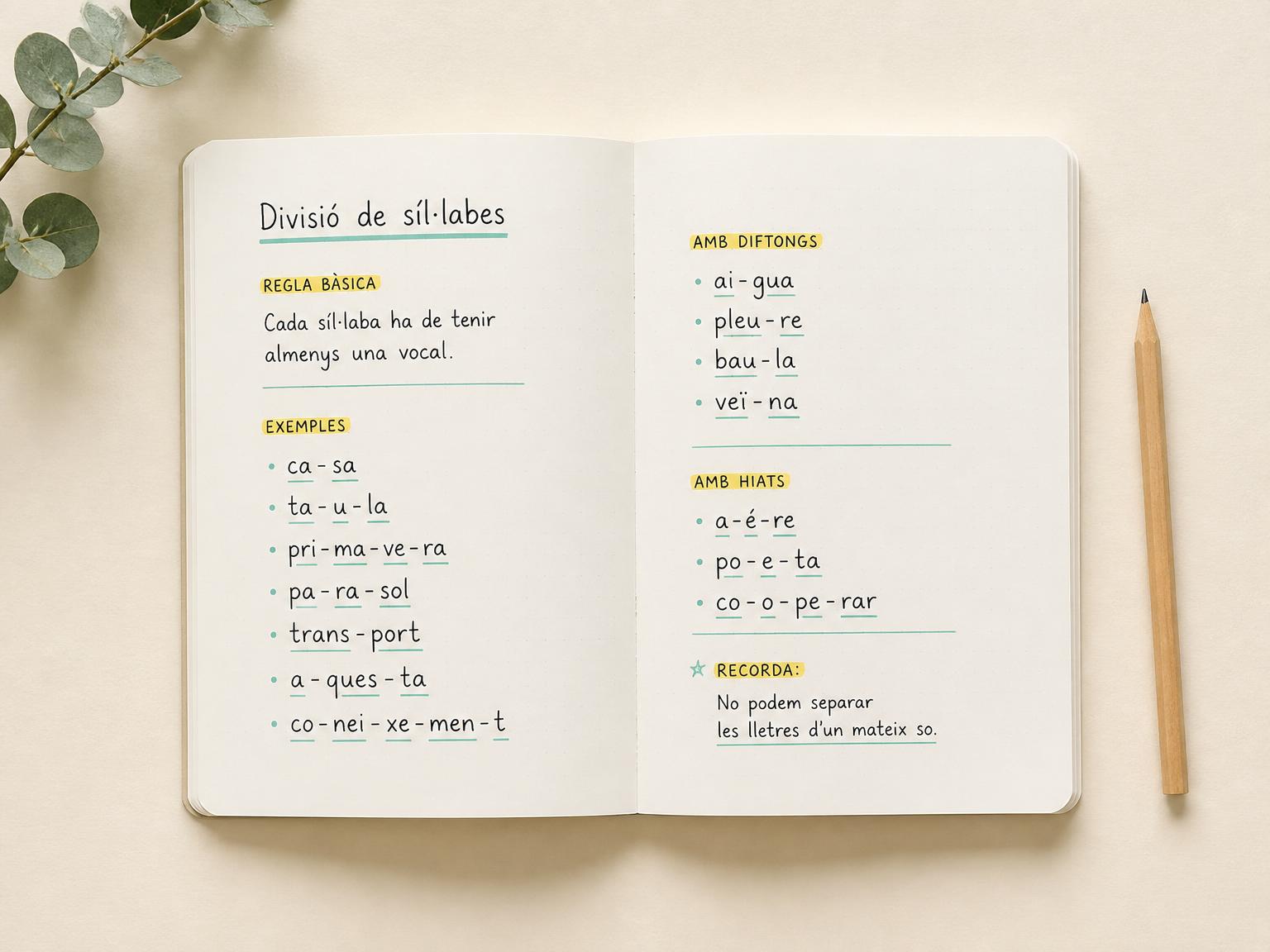
After eighteen years correcting texts from students of every level —from secondary school to C2, including the PAU university entrance exams—, I can say one thing with confidence: most spelling mistakes in Catalan do not come from not knowing the rules. They come from not seeing the syllable.
It sounds too simple to be true, so let me show you with the same starting point I use in class.
Every syllable needs a nucleus, and that nucleus is always a vowel. This sentence, which sounds like primary school material, is the keystone of Catalan spelling. If you can find the nucleus of each syllable, you can split the word. And if you can split the word, accentuation —the biggest source of mistakes— becomes a mechanical procedure: you find the stressed syllable, look at how the word ends, and apply a rule that no longer fails.
The problem is that nobody taught us to split words properly. The doubts always cluster in the same places. Five digraphs are never split: qu, gu, ny, ll and ig — which is why it is qua-tre and co-lla, not quat-re or col-la. An i or u between two vowels opens the next syllable: bo-ia, ca-uen, quo-ta. And the groups qüe, qüi, güe and güi always form a diphthong, unlike que, qui, gue and gui. Four ideas like these, properly understood, instantly deactivate a huge share of the mistakes I see every week.
Why do I say it can be done in four hours? Because I have systematised it. «La teoria de la síl·laba®» is my registered method, designed as two two-hour sessions: the first works on syllable theory (splitting, seeing the nucleus, recognising diphthongs and digraphs) and the second on accentuation theory, which builds directly on the first. It is not magic: it is order. The rules behind the vast majority of common mistakes are few, and once you understand them as a system —not as a list to memorise— they stop slipping away.
Who does it work for? I have used it with secondary and high-school students whose exam marks were at stake, with public-exam candidates who needed to get rid of mistakes for the C1 and C2, and with adults who wrote Catalan every day at work without confidence. The pattern repeats: they did not lack ability, they lacked the mechanism.
If you want to start on your own, the complete method is in the Quadern de la teoria de la síl·laba, a laminated A5 physical workbook with the whole system, practical exercises and a code that unlocks the online course so you can practise at your own pace. And if you would rather have me explain it to you directly, book a class: in one session we assess your starting point and map the way forward.
Because writing without mistakes is not a question of talent. It is a question of method.