5 September 2026 · Sara Marugan
Joan Miró's «Dona i Ocell» sculpture
This article was machine-translated from Sara's Catalan original. The writing is hers; the translation has not been reviewed by a person. Read the Catalan original →
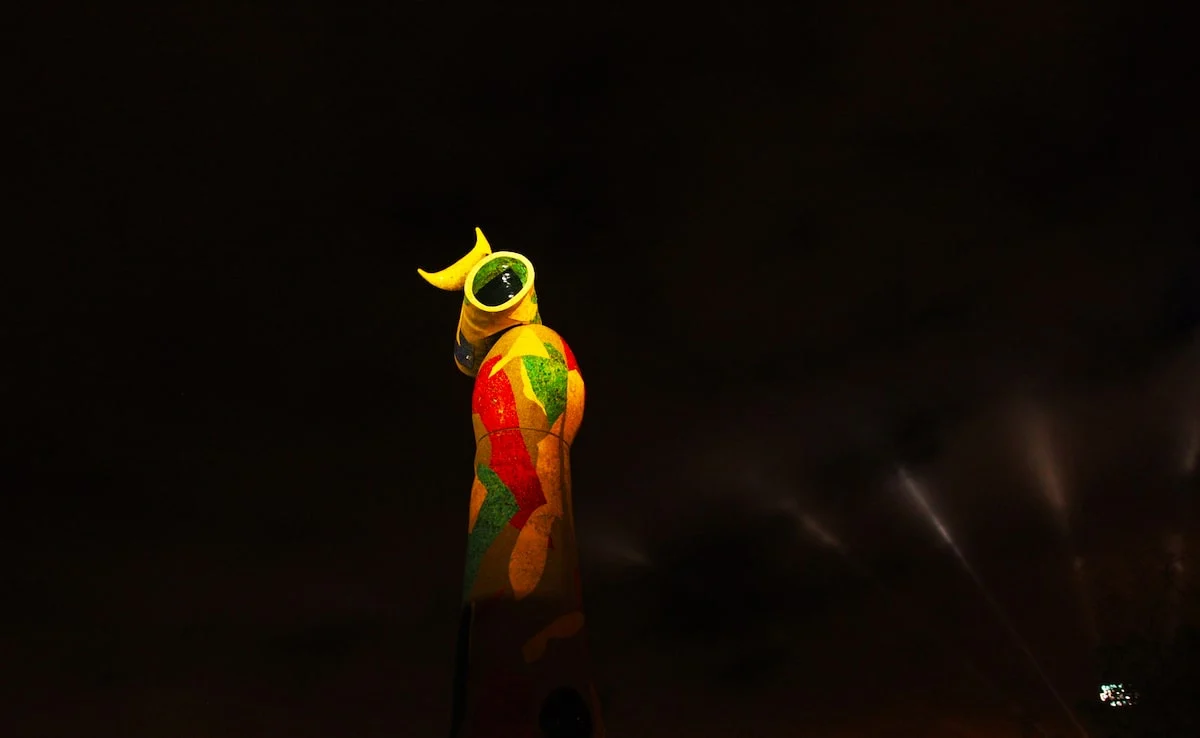
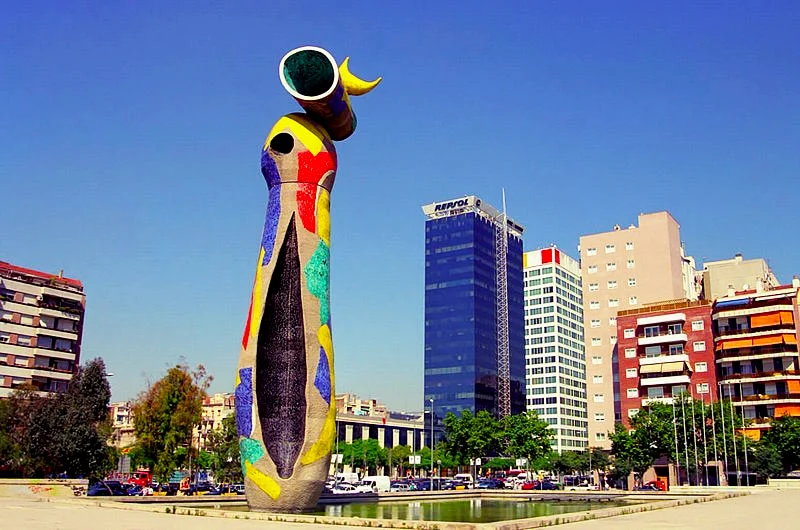
This free-standing sculpture, 22 metres tall, was unveiled in 1983. Made of concrete and painted ceramic using Gaudí's trencadís technique, it was produced by Joan Miró together with Joan Gardy Artigas, and it is a key piece of Barcelona's public sculpture.
It rises as an organic form — a mushroom, a stem, or something with a masculine echo — crowned by an uneven cylinder and a yellow half-moon. At the bottom there is a vertical black opening: the darkness of the mystery in the artist's iconography. Titled Dona i ocell (Woman and Bird), like other works by Miró, it evokes a femininity defined by that black incision as a reminder of the vulva.
For Joan Miró, woman is the whole universe, and she is completed by the phallic form of the sculpture. Woman is the telluric, rooted in the earth. At the top, the bird: the symbol of human escape towards the sky, the moon and the stars, of what can fly free towards other realities and take us away from the earthly plane. Over the years Miró built a personal, unmistakable language tied to the surrealist tradition, in which woman, bird, stars, moon and ladder are visual signs of a poetics that goes beyond mere matter and lifts us into the world of ideas, dreams and thought.
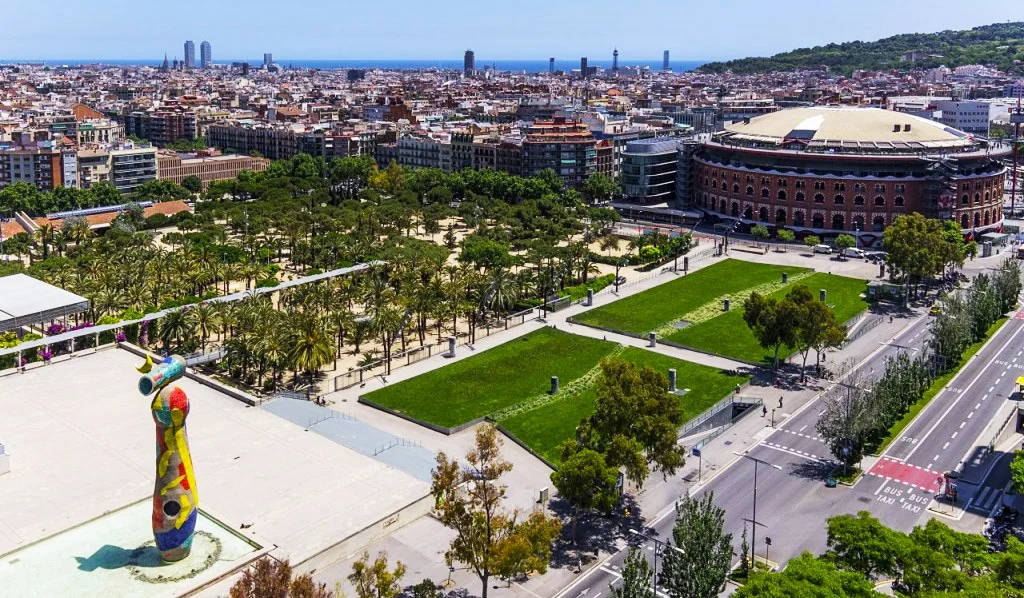
The work was commissioned by Barcelona City Council as part of the redevelopment of the former Parc de l'Escorxador. The site of the city's old slaughterhouse, demolished in 1978, became today's Parc Joan Miró, presided over by the sculpture. Anyone arriving in or leaving Barcelona by train at Sants station is welcomed or seen off by Joan Miró. And although it was not part of the original public-sculpture project begun in 1968, it complements it well.
So what was that project of the sixties? Barcelona City Council suggested that Miró make one of his well-known ceramic murals to welcome visitors arriving at the city's airport. Miró loved the idea and said he would not only make a work for the airport — installed in 1970 — but would design two more, welcoming visitors according to how they arrived: by land, by sea or by air.
Of those other two, the ceramic pavement at Pla de la Boqueria on the Ramblas stands out — the Mosaic del Pla de l'Os, unveiled in 1976 — which greeted those arriving at the port. The third was to be a sculpture in Parc de Cervantes, making the same gesture at the entrance to the city along the old main road; the project was never built, and its model is kept in the north courtyard of the Fundació Joan Miró in Barcelona.
If you would like a different view of the sculpture and of the park as a whole, go up to the terraces of Les Arenes shopping centre and look down on it from above, whenever the rules allow. From there you can also see how the old neo-Mudéjar bullring, designed by the architect August Font i Carreras in 1900, was turned by the architect Richard Rogers into a shopping centre that opened in 2011.
Text written by Jose Ortiz, guide at the Centre Europeu de Barcelona.