2 August 2026 · Sara Marugan
A philosophical essay on Hobbes and Locke
This article was machine-translated from Sara's Catalan original. The writing is hers; the translation has not been reviewed by a person. Read the Catalan original →
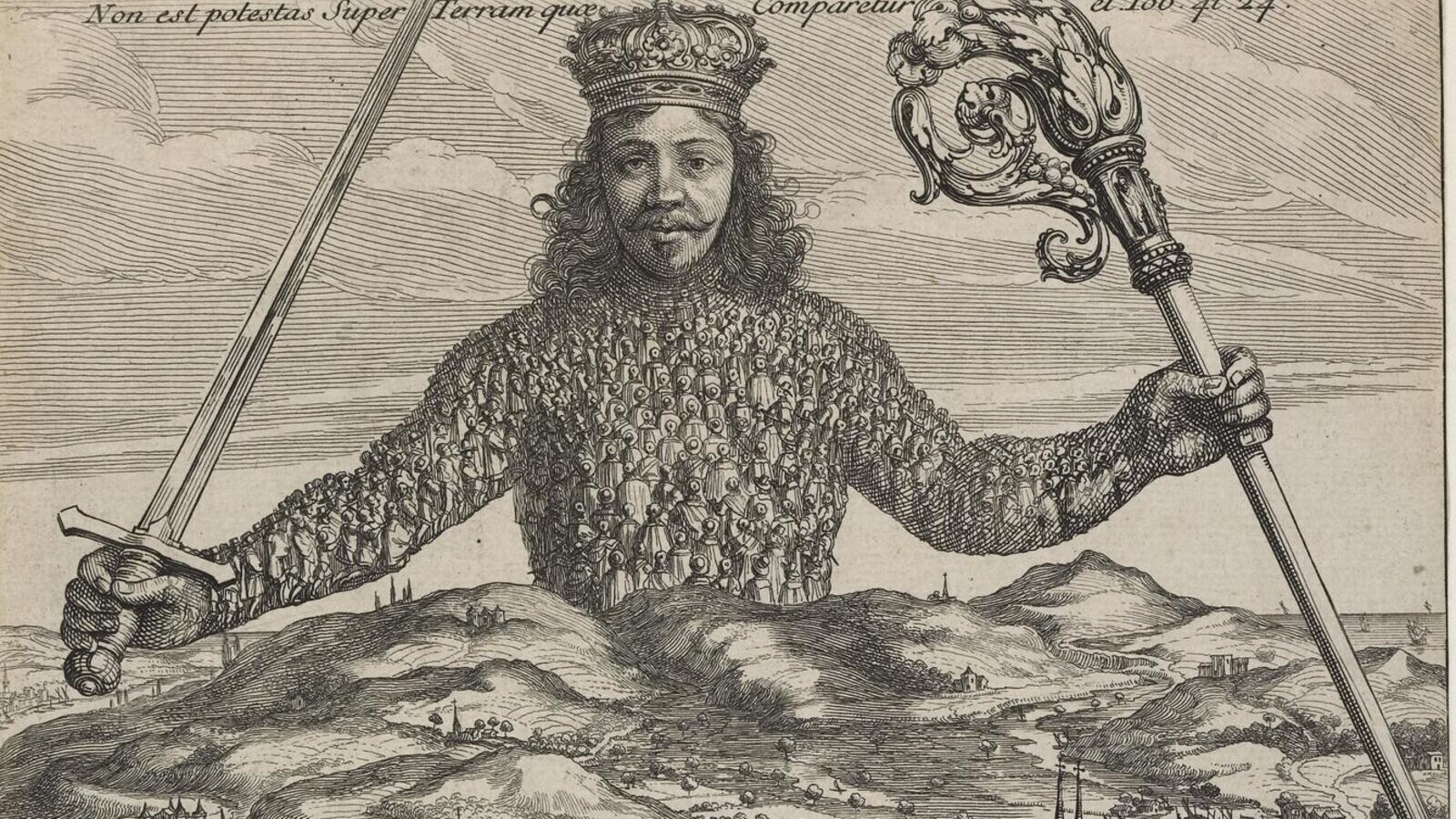
Hobbes, Locke and Rousseau
State of nature
Hobbes
- Chaos, in which competition and mutual distrust prevail.
- A war of all against all.
- «Homo homini lupus»
Locke
- A state of freedom and cooperation where reason and natural law can guide human interaction.
- Natural rights, including the natural right of jurisdiction and private property.
Rousseau
- An idyllic state of harmony and fellowship, where inequality arises with private property and civilisation.
The social contract
Hobbes
- Unconditional surrender of individual rights to an absolute monarch with unlimited power to keep order and prevent a return to the state of nature.
Locke
- Individual rights are ceded only so long as power protects and coordinates citizens effectively.
- Rebellion is legitimate if power becomes ineffective or corrupt.
Rousseau
- Individuals undertake to submit to the General Will in exchange for taking part in it.
- The General Will seeks the common good.
Constituted power
Hobbes
- The Leviathan (an absolute monarch) guaranteeing security and social stability.
- Centralised, strong power, meant to prevent chaos and anarchy.
Locke
- Parliamentary monarchy.
- Representative democracy.
- Limited government, based on the rule of law and parliament.
Rousseau
- Republic.
- Direct democracy.
- The sovereign people legislate through the General Will.
What a philosophical essay is
An essay of this kind sets out a reasoned, well-founded opinion on a particular subject. It requires:
- Expressing an opinion, which is not the same as voicing a passing impression.
- That the opinion you defend is your own, not someone else's.
- Grounding your opinion in major authors.
- And the key to it all: good argument.
What is the true state of nature of the human being? Can this question be answered scientifically?
The state of nature of the human being is still debated among philosophers: we might define it as a hypothetical way of living for human beings without rules inside a community. Hobbes and Locke offered opposing views on the question. For Hobbes, the state of nature is marked by fear and insecurity, and he would associate it with chaos, given the absence of laws and figures of authority: humans would compete for resources and live in a war of all against all, in which life could become «solitary, poor, nasty, brutish and short».
Locke, by contrast, would associate that state with a more optimistic outlook, since he holds that humans are capable of respecting the fundamental rights of others — life, liberty and property. Moreover, although conflicts over power may arise, he believes most humans would live in peace thanks to their capacity to reason and to organise themselves without any need for absolute power.
We have no examples of societies that have lived through a pure state of nature over time, but neither can we claim that it is something that cannot work: humans do not have to be evil by nature. They can absorb knowledge like sponges, and experiences too, and those experiences can define us as people.
That said, despite the differences between Hobbes and Locke, it is difficult to answer this question scientifically, because the state of nature is a theoretical construction rather than a tangible, empirically verifiable fact. My own view is that Locke's social contract might be the one that best fits the state of nature, since it removes the initial problem of one single person holding all the power with no freedom of opinion, and it also regulates that power, taking away its ability to do as it pleases.
It is true that such a social contract may cost some of the economic and social freedom that would exist in a state of nature free of power. Even so, the three fundamental rights mentioned above would be upheld, unlike under absolute power; and it would guarantee that, if the system failed and power became corrupt, a legitimate rebellion would certainly follow.