29 July 2026 · Sara Marugan
Online Catalan classes: how they work and how to get the most out of them
This article was machine-translated from Sara's Catalan original. The writing is hers; the translation has not been reviewed by a person. Read the Catalan original →
When I moved all my classes online, some students had doubts: can you really learn Catalan over video call? Years later, the answer is a resounding yes — but not just any online class will do. Let me explain how I work and, along the way, what you should demand from any online Catalan class.
My first rule: one-to-one means one-to-one. Every student arrives with a different goal —passing the C1, preparing the PAU, losing the insecurity at work, polishing a thesis— and a different starting point. That is why I have no fixed syllabus: the theory adapts to what you need, and the materials are chosen for you. In a group class that is impossible by definition.
Second rule: you work in class, and between classes too. The live session is for explaining, resolving doubts and practising what is hardest. But real progress happens between classes: that is why my students take away extra materials, exercises and texts to write. And everything they write comes back corrected and commented, because personalised correction is where you learn the most: seeing your own specific mistakes, not the generic mistakes in a textbook.
Third rule: if you are preparing an official exam, you must practise with the real format. I work with exam models of the same type as the official tests, because knowing the language and being able to demonstrate it in an exam are two different skills. As an official marker and examiner of tests such as the PAU, the C1 and the C2, I know exactly what earns marks and what loses them — and I pour that into my classes.
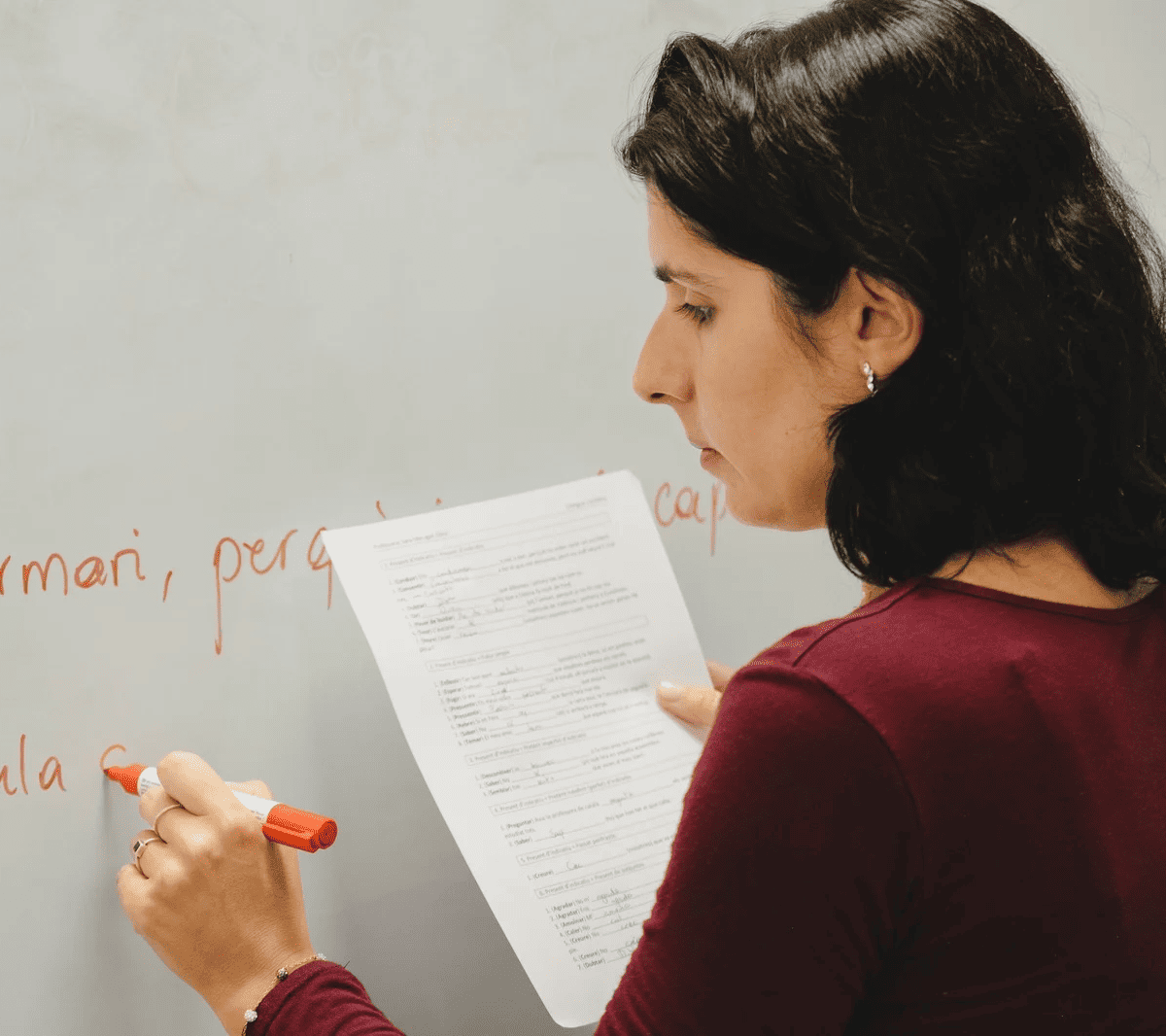
And what does the online format add? More than it seems. You lose no time travelling, so it is easier to keep up the regularity that actually drives progress. You can have your class from anywhere. All your materials stay organised digitally in your own space, always at hand. And the shared whiteboard and on-screen correction make the session as hands-on as an in-person one — often more, because everything ends up in writing.
Who does it work for? I teach secondary and high-school students (with specific PAU preparation), complete beginners, public-exam candidates and professionals preparing the C1 or C2, university students who need to polish a thesis, and even Catalan teachers who want reinforcement in a specific area. Each profile works differently, and that is exactly why the one-to-one format makes sense.
If you are considering it, my advice is simple: try it. Book a first class from the website —you pick a day and time on the calendar and it is confirmed instantly—, tell me your goal, and after one session you will know whether this way of working is for you. Catalan, like any language, is not memorised: it is trained. And training with someone who corrects your every step is the most honest shortcut I know.